


Nature Impact Score
The NIS is a methodology to evaluate and communicate a product’s environmental, circularity, and health impact, allowing businesses and consumers to understand its overall impact on nature and people. The NIS quantifies this performance as a score that is visually expressed on a scale from green to red where green means (very) low negative environmental impact and red means (very) high negative environmental impact.
Display the NIS publicly, integrate it into web shops, and easily compare sustainability across industries, all with credibility ensured by independent verification.
Key Features:

Universal comparability:
Easily compare sustainability across industries.

Supplier management:
Connect suppliers and retailers seamlessly.

Webshop integration:
Integrate effortlessly via API for streamlined processes.

Automated assessments:
Enjoy efficiency with automated digital evaluations.

Data integration:
Incorporate existing LCA/EPD data or Bills of Materials.

Third-party verification:
Ensure credibility with independent auditor verification.
Based on international standards, GSES has developed its House of Sustainability
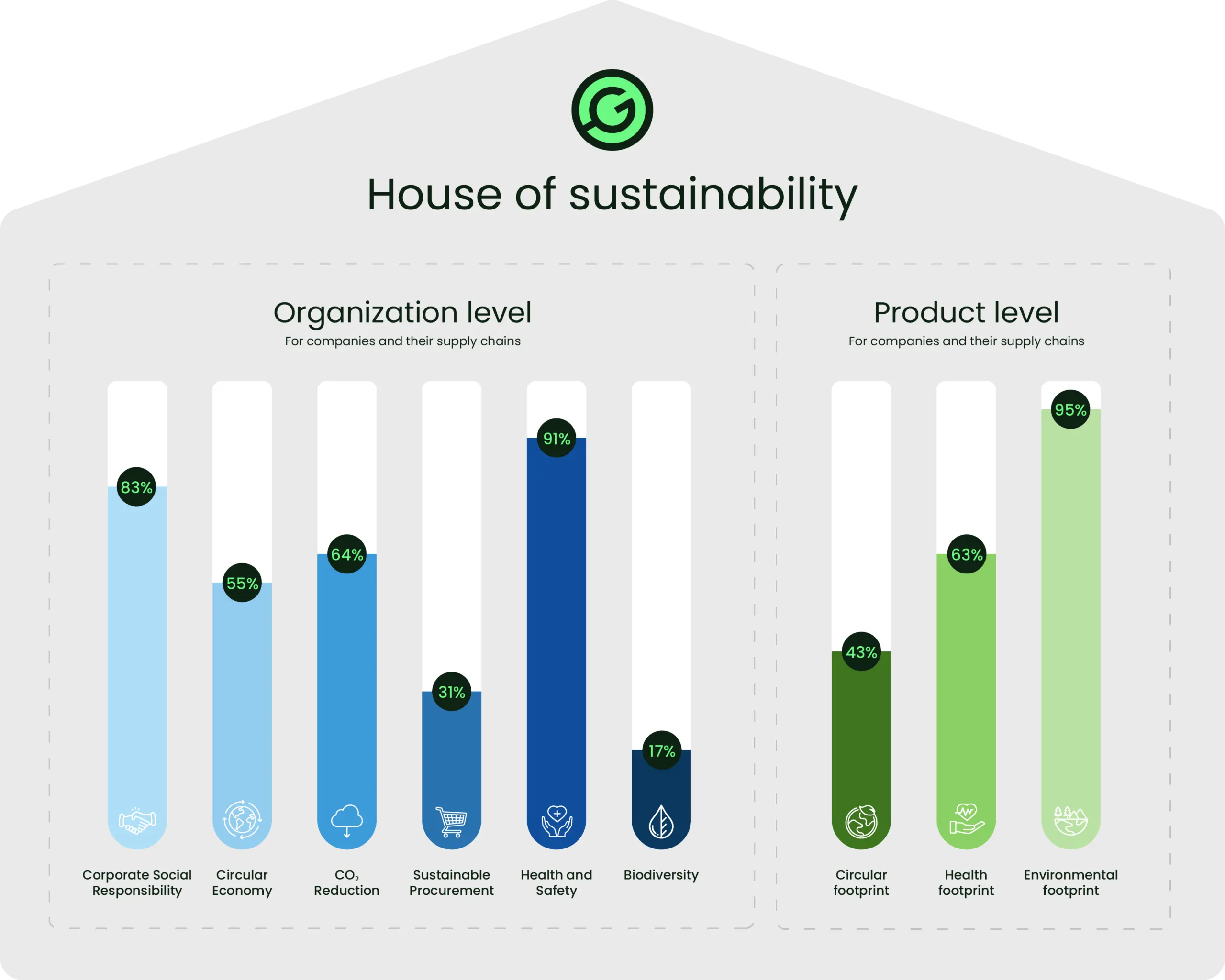
Responsibility
Economy
Reduction
Procurement
Safety
Footprint
Footprint
Footprint
The GSES benchmark translates ± 500 international ESG certificates into underlying KPIs and makes them clear and therefore comparable! Organizations without certificates can perform assessments to demonstrate sustainability performance on the same benchmark.
How it works
The NIS is a composite score, based on a set of qualitative and quantitative indicators that evaluate impacts across three key dimensions, referred to as ‘Footprints’. The three footprints are:
Each Footprint evaluates a different aspect of a product’s impact using a defined set of indicators. The results of these indicators are aggregated into a Footprint score, which ranges from 0% to 100%. The NIS of a product is subsequently calculated as the average of the three Footprint scores, with each Footprint contributing equally.
The Circular Footprint measures a product’s material circularity, using principles from standards such as the Ellen MacArthur Foundation’s Material Circularity Indicator, Cradle to Cradle’s Material Reutilization Ratio, and the Dutch Green Building Council’s Disassembly Potential method.
The Health Footprint assesses toxic and hazardous substances in products and during manufacturing, aligning with REACH and other leading EU regulations on chemical safety.
The Environmental Footprint evaluates the environmental impact of manufacturing and supply chains, following LCA standards such as ISO 14040, ISO 14044 and PEF.