

As a valued supplier to the Royal Schiphol Group, you’re not just our partner—you’re a driving force in creating the world’s most sustainable airports.
In line with our commitment to sustainability and transparency, we (Royal Schiphol Group) are taking steps to gain insight into the social and environmental impact of our supply chain. We do this using the Global Sustainable Enterprise System (GSES). This platform helps us identify and collaborate with suppliers who share our dedication to responsible and future focused practices.
As our supplier, we ask you to join us in driving positive change in the aviation sector by supplying your sustainability information through the GSES platform. Doing this you supply validated sustainability data to us (and potential other clients), while also gaining insight into your own sustainability performance and goals.

About GSES
The GSES platform is a universal, sector-agnostic solution for measuring, rating and verifying sustainability performance across sustainability themes and scopes.
With a holistic approach, the platform covers sustainability on every front — from your own organization to your supply chain, products, and physical assets — while aiding in compliance with key legislation such as CSRD, EUDR, and DPP, among others.
All data on the GSES platform is verified by independent third parties, such as accredited certification bodies. This verification process is central to our mission: it prevents greenwashing and ensures fair, transparent, and comparable sustainability performance measurement and reporting across organizations.
Want to learn more? Book a free demo and discover how GSES can support your sustainability journey.
What does Schiphol ask from its suppliers?
As part of Schiphol’s Supplier Check-In process, suppliers are asked to share verified sustainability data. This request is handled separately through the GSES platform, but is an integral part of the Check-In.
Your organization is therefore asked to:
- Enter your sustainability data into the GSES platform, by completing the applicable GSES assessments.
- Have this data verified through the platform by an independent certifier.
- Obtain a GSES Pro membership, which is required to fulfill this request.
Schiphol distinguishes between two groups of suppliers: Asset and IT/Services suppliers.
A tailored data request has been formulated for each group, ensuring that the information collected is relevant to the type of products or services delivered.

CSR
Corporate Social Responsibility

CO₂
CO2 Reduction

CE
Circular Economy

SP
Sustainable Procurement
CSR
Corporate Social Responsibility
CO₂
CO2 Reduction

HS
Health & Safety
SP
Sustainable Procurement
Participation in the GSES platform may also be required in Schiphol tenders, in addition to being part of the Check-In process. By providing this data, suppliers contribute to Schiphol’s broader sustainability goals and help create a transparent, measurable, and verifiable basis for working together on impact reduction.
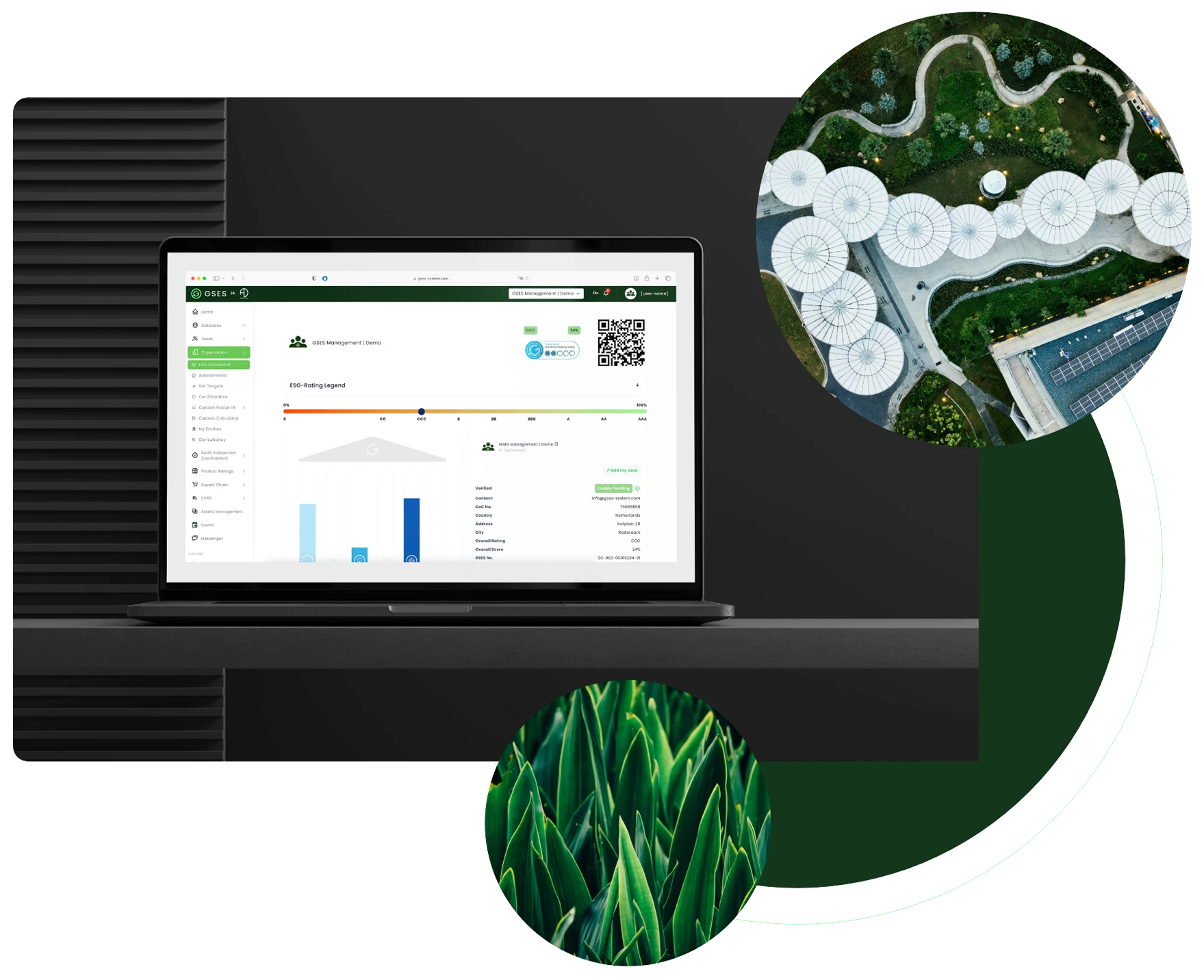
Fill in the info below to get the membership you need to fulfill the Schiphol request
Please provide your company details to get started with the information request.
GSES will subsequently contact you to provide a quote and set out next steps.
Book a demo
Want to know more about GSES? If you have any questions or want to book a demo, use the link below.
How to do it
Register on the GSES Platform
FAQ
To share the required sustainability data with the Royal Schiphol Group, your organization needs a GSES Pro membership. This membership allows you to create and share an ESG scorecard, manage certificates, comply with GSES assessments, track CO₂ emissions, and collaborate with up to five colleagues.
You can upload your organization’s existing certificates to receive a baseline assessment and complete the full GSES assessment process. A Pro membership includes four annual assessment reviews (desk audits), all of which are independently validated through the GSES platform.
With your ESG scorecard, you can monitor your sustainability performance, set future goals, communicate and share your data with clients and other stakeholders, and leverage your performance for external communication purposes.
Schiphol wants to work with its suppliers towards a sustainable and future-proof airport. To do this in a transparent and measurable way, Schiphol requests suppliers to share verified sustainability data. This helps to gain insights into the supply chain and to track progress together.
Yes. The request to provide sustainability data is part of Schiphol’s Supplier Check-In process. The actual data collection and verification takes place separately through the GSES platform, but it is considered an integral element of the Check-In.
An important part of the Check-In is also the continuous improvement of your GSES score on the platform.
-
Enter your sustainability data into the GSES platform.
-
Have this data verified by an independent certifying body via the platform.
-
Obtain a GSES membership, which is required to complete this process.
-
Work on improving your GSES score over time, as part of the Supplier Check-In.
-
Asset suppliers
-
IT/Services suppliers
For both groups, a specific data request has been formulated to ensure that the information collected is relevant to the products or services delivered.
Participation in the GSES platform is part of the Supplier Check-In. In addition, it may also be a requirement in Schiphol tenders. We therefore strongly advise suppliers to participate, as it can influence both ongoing and future business opportunities with Schiphol.
- Data ownership remains with your organization. GSES only processes the data and does not claim ownership.
- Certificates (e.g. ISO, CO₂ Performance Ladder) are uploaded by you and validated by an independent certifying body.
- Assessment answers are verified and shown on your scorecard; answers cannot be edited after submission.
- Burden of proof (e.g. internal documents) is stored in a Virtual Safe and only accessible to you and the auditor. The documents are not visible on your scorecard.
Data ownership and accessibility.
- The information you provide remains the property of your organization. GSES will only have the right to process the data, without transferring ownership rights.
- You always have full access to your organization’s own information and can view it.
- Important: After submitting an assessment, you cannot edit your answers anymore.
Processing and visibility of certificates (ISO, CO2 Performance Ladder, Ecovadis, etc.)
- Certificates are uploaded by you and forwarded to an independent certifying body for validation.
- You can always view and/or delete your organization’s certificates.
- The scorecard will display the certificate’s logo, including its validation status and validity.
- The score report states whether a certificate contributes to your score. The certificate itself cannot be downloaded by others.
Processing and visibility of assessments and burden of proof
- When filling in a questionnaire, the following elements are recorded:
- Answer: multiple-choice options from the GSES Standard
- Context: explanation for the auditor
- Burden of proof: internal documents as burden of proof
How is this processed and visible?
- The answer will be visible on the scorecard after verification.
- The burden of proof is stored in a secure safe. Only your organization and the auditor have access to this. This is not visible on the scorecard.
Organizations are fully responsible for the accuracy and ownership of any data uploaded to the platform. By submitting data, they confirm it is truthful and accurate to the best of their knowledge.
Auditors independently assess whether the data is verifiable and meets the required standards. The platform itself is not responsible for the content or accuracy of submitted data.
The largest time commitment for your organization is in qualitatively answering the assessments and collecting the underlying documents that serve as evidence. Below is an overview of the processing times.
Time commitment and lead time:
- Create an account: 2 minutes for you as a user (name & email address) to register your organization.
- Uploading certificates and requesting validation: up to 5 minutes.
Lead time of independent audit by certifying body:
- Validation of 1st line certificate: 2 working days.
- Validation 2nd-line certificate: 10 working days.
- Verification of Assessments by means of a desk audit: 10 – 15 working days.
You may need various colleagues to fill in the assessment, this can differ per organization but also per GSES Pillar. Think of colleagues from a sustainability team or the contract and procurement team. You can give up to 5 colleagues access to your organization’s online environment.
Are you excited and ready to get started? We will help you on your way. On this landing page you will find all the steps you need to follow in the “Getting started with GSES” section.
By providing verified sustainability data and actively improving your GSES score, your organization demonstrates transparency and commitment to sustainability. This strengthens your partnership with Schiphol and aligns your organization with Schiphol’s broader environmental and social impact goals.
In addition to the functionalities that a GSES Pro membership brings, your organization can do much more with the GSES platform, for example, the GSES platform can:
- Enter and validate sustainability information about your products.
- Mapping the sustainability performance of your supply chain.
- Use other parts of the platform such as the CSRD module, the event module and/or the asset module;
- Compare suppliers on sustainability performance in the GSES database.
If you want to know more about the above functionalities and possibilities for your organization, book a demo or contact the GSES Support Team at [email protected].
This FAQ is updated regularly. If you have additional questions feel free to contact us on [email protected]