


Kelly Ruigrok receives Uber FCN Jewel Award for female leadership
Kelly Ruigrok receives Uber FCN Jewel Award for female leadership

Amsterdam, November 05, 2025
Kelly Ruigrok, Founder and CEO of the Global Sustainable Enterprise System (GSES), has been honored with the Uber FCN Jewel Award for Female Leadership during the 15th edition of the FCN Jewel Awards, held at the Concertgebouw in Amsterdam.
The award recognizes female leaders who drive change through innovation, connection, and decisive action. The presentation was made by Saskia de Jongh, Vice President of Uber Eats, who praised Ruigrok for her remarkable leadership journey:
“From cleaner to CEO of an international sustainability platform Kelly shows how purpose-driven leadership can truly change systems.”
Leadership with Measurable Impact
Under Ruigrok’s leadership, GSES has grown into a global platform for measuring and improving sustainability, transparency, and circular performance across supply chains. Governments, multinationals, SMEs, and suppliers use the system to make their sustainability achievements visible and verifiable.
“I dedicate this award to my team, our partners, and our clients around the world,” said Ruigrok.
“Female leadership isn’t just about having more women at the table it’s about building with purpose, courage, and collaboration. Sustainability demands a new kind of leadership and we’ve only just begun.”
Female Leadership as a Driver of Sustainable Transformation
A growing number of international studies show that female leaders are faster to implement sustainable innovations, build more inclusive organizations, and focus on long-term value for society and the environment. The Uber FCN Jewel Award highlights this evolution and honors women who are reshaping industries through impact-driven leadership.
During the evening, other outstanding female entrepreneurs were also recognized.
Gunay Uslu (Corendon) received the Business Excellence Jewel Award, and Marianne Baars, CEO of NewFysic, was also honored.
The award trophies were designed by artist Micky Hoogendijk, who created unique artistic pieces symbolizing strength and transformation.
Ruigrok concluded her acceptance speech with a powerful statement:
“Female leadership is not a trend it’s the future of sustainable growth. Here’s to even more impact. Let’s lead. Let’s build. Let’s shake systems.”
About the FCN Jewel Awards
The FCN Jewel Awards, organized by the Founders Carbon Network (FCN), annually bring together entrepreneurs, executives, and impact makers. Previous winners include Pieter Zwart, Won Yip, and Jopie Geerts.
About GSES
The Global Sustainable Enterprise System (GSES) is the world’s first universal sustainability assessment system integrating ESG, circularity, and certification data. The platform is used globally by organizations and governments seeking to manage and report their impact transparently.
Share this post


GSES System and Open House strengthen partnership at ADE
GSES System and Open House strengthen partnership at ADE

Amsterdam, October 23, 2025
During the Amsterdam Dance Event (ADE), GSES System (Global Sustainable Enterprise System) and the Open House Foundation officially signed their strategic partnership. The collaboration focuses on making the Dutch and international events industry more sustainable by ensuring that sustainability becomes measurable, verifiable, and transparent. Open House receives a global license, enabling clear insight into the impact of events. In addition, both organizations will collaborate on sustainability initiatives aimed at reducing the negative footprint of events while enhancing their social and societal impact.
The signing at ADE marks the official continuation of the partnership first announced earlier this year during the Beyond Barrier Lines event, where the organizations presented their shared vision for a more circular and data-driven future within the creative sector.
“The event industry has enormous impact — both culturally and ecologically. Through this collaboration, we combine the power of data and community to achieve real, measurable progress,” said Kelly Ruigrok, CEO of GSES System.
“By connecting GSES’s tools with the knowledge, experience, and execution power of Open House in the Dutch and international events sector, we can set the standard for sustainable events,” added Yoël Schuller, General Manager and expert at the Open House Foundation.
The collaboration includes the development and implementation of a unified sustainability framework for festivals, venues, and cultural organizations. This framework will allow event organizers to measure and present their environmental impact, circularity, and social value through the GSES platform, which is based on globally recognized measurement methodologies.
“What starts in the Netherlands can make a difference worldwide. We aim to turn this partnership into a Dutch export product: a model where sustainability, innovation, and creativity reinforce each other,” concluded Ruigrok.
About GSES System
The Global Sustainable Enterprise System (GSES) is an internationally recognized sustainability platform that helps organizations measure and improve their performance based on global standards.
The platform offers tools for certification, supply chain transparency, and impact verification, and has experience across diverse sectors including construction, mobility, government, and large-scale events.
About the Open House Foundation
The Open House Foundation connects, accelerates, and innovates — with one goal: a strong, sustainable, and attractive sector ready for the future. Open House operates as an independent platform and connector between government, education, and business.
By bringing together knowledge, tools, and networks, the foundation delivers tangible results: more talent, less environmental impact, and a stronger international profile. Together with its partners, Open House achieves measurable impact and helps build a sector that is proud, resilient, and future-oriented.
Share this post

Sustainable Procurement: Measuring is Improving
News
Sustainable Procurement: Measuring is Improving
Being transparent about sustainability efforts and results is key to sustainable procurement. The Global Sustainable Enterprise System provides a platform for this; expert Karin van IJsselmuide. Univé and Air Traffic Control the Netherlands (LVNL) have already started using it.
Sustainable procurement refers to purchasing with the most positive effects for society, the economy, and the environment throughout the entire product lifecycle (ISO 20400-2017). This term for sustainable purchasing is used internationally by businesses and is equivalent to the government’s term “socially responsible procurement.” Procurement organizations can have a significant impact on achieving sustainable goals, such as the Sustainable Development Goals (SDGs). Moreover, numerous regulations and legislative proposals are emerging, such as CSRD, IMVO, and CO2 reporting, which require organizations to be accountable. This is a good reason to start working on it, but in a clear, correct, and verifiable way.
5 Guidelines from the ACM
If there’s one thing we’ve learned from recent investigations and the sanctions imposed by the Dutch Consumer and Market Authority (ACM), it’s that some companies make a habit of pretending to be more sustainable than they actually are. Sustainability has become more of a marketing tool, which we call greenwashing. The five guidelines that ACM has issued offer support for both marketing and procurement departments:
- Clearly communicate the sustainability benefits of the product.
- Substantiate sustainability claims with facts and keep them up to date.
- Comparisons with other products, services, or companies should be fair.
- Be honest and concrete about sustainability efforts.
- Ensure that visual claims and labels are helpful and not confusing for consumers.
Being transparent and honest about sustainability efforts and results is central to sustainable procurement. Having an ambition, sustainable purchasing policy, or action plan to address sustainability is not enough. It is necessary to measure and substantiate sustainable procurement activities with facts. But where do you start, and how do you ensure that your own procurement process, suppliers, and the products they deliver do not rely on opportunistic sustainability claims? For this, we use the process of: tell me, show me, and prove me.
Tell me, show me, and prove me
Tell me: Start by having suppliers explain how sustainable they already are in areas such as circularity, CO2 reduction, employee health and safety. Show me: Once you have insight into the sustainability of your suppliers, ask whether they can substantiate the claims they’ve made and the information provided with facts or evidence. Prove me: If you have doubts about the facts provided or if the stakes are high for your organization, you can have the evidence verified by an independent expert or certifying body such as KIWA or Control Union.
Sustainability Labels
Since organizations often do not have all the expertise in-house or the ability to manage and verify sustainability data provided, it is helpful that sustainability labels exist. But how do you know if a label is recognized and validated? Gaining knowledge about this, creating your own questionnaires, and setting up the verification process are often not feasible for companies. Furthermore, it is not ideal for the market for every customer to ask for slightly different requirements on various themes.
Unique Standard
If the organization decides to request, analyze, and verify data from suppliers, it’s important to think carefully about the strategy behind it. And also consider the tool you need to help with this. There are various tools on the market that can assist with this, such as the Global Sustainable Enterprise System (GSES). This is a platform where you can see how each supplier addresses various sustainability themes. GSES uses a unique overarching standard for measuring the sustainability of organizations and products. This standard recognizes over five hundred existing sustainability standards, certifications, and eco-labels.
Based on this, GSES can measure the sustainability performance of organizations and products in areas such as sustainable procurement, CSR, CO2, circularity, health, safety, and biodiversity. Parties using GSES to measure their own or their products’ sustainability follow a standardized process. Depending on the sustainability theme being investigated, the organization undergoes an assessment and is asked to provide evidence. This evidence is externally verified as part of the process. The result is a standardized scorecard that shows the sustainability performance of the organization or product. This gives you a clear picture of your sustainability score, and you can zoom in on different areas. And all of this is based on verified information, ensuring transparency. With the supply chain dashboard, you also gain insight into the sustainability of your suppliers and have an immediate benchmark.
GSES House of Sustainability
The GSES House of Sustainability is a graphical representation (see the image on the next page) of the six sustainability perspectives measured by GSES:
- Corporate Social Responsibility (based on ISO 26000)
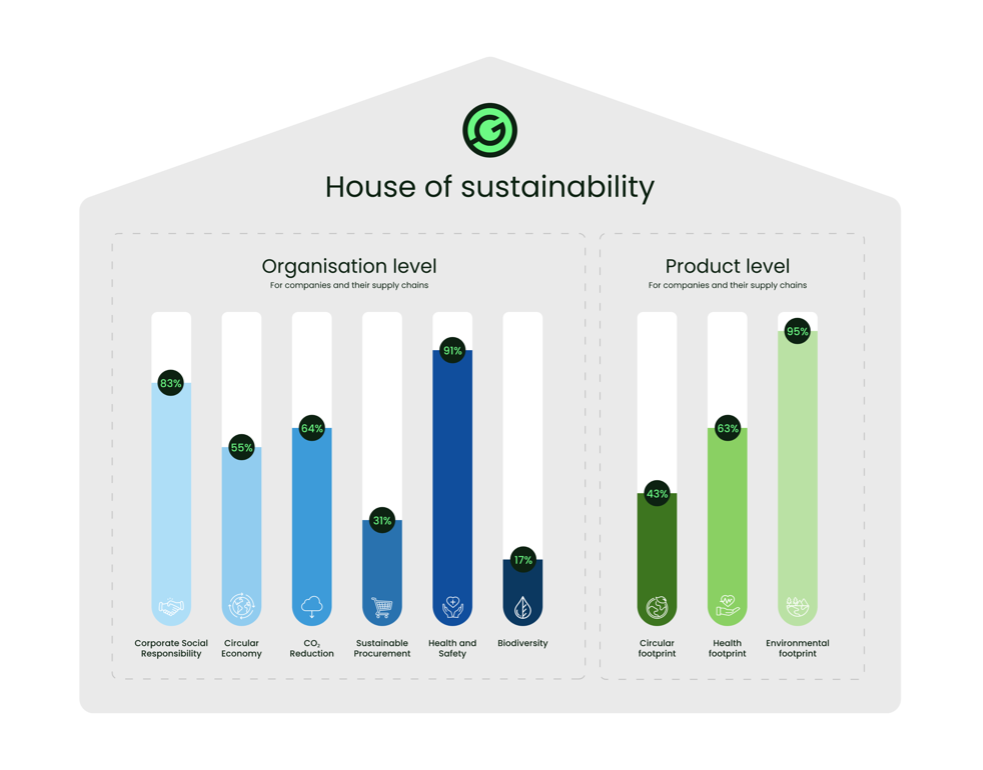
- Sustainable Procurement (based on ISO 20400)
- Biodiversity (based on UNDP)
- Circular Economy (based on BS 8001)
- Health and Safety (based on ISO 45001)
- CO2 Reduction (based on ISO 50001, ISO 14064-1)
In the Netherlands, GSES works with companies such as Xenos, Wibra, ABN AMRO, Univé, the Ministry of Foreign Affairs, and Air Traffic Control the Netherlands (LVNL).
In the two boxes, strategic procurement advisor Willem de Jager of Univé Group and contracting manager Eric Sessink of LVNL share their experiences with GSES.
Action Plan
Sustainability measurement is just the beginning. It’s good to know where every supplier stands, but embedding the real strategy only begins after that. It’s recommended to establish an action plan. This allows you to start discussions with suppliers about their contribution to your own sustainability goals and/or include sustainability ambitions in contracts.
Insight
To really make progress in this area, insight is essential. The requirements that sustainable procurement places on organizations and individuals will grow with future legislation and market developments. Therefore, sustainability will always remain a key concern for the procurement discipline in the future.
UNIVÉ GROUP

Willem de Jager, strategic procurement advisor at Univé Group: “In the context of CSR, Univé focuses on all Sustainable Development Goals, with extra emphasis on ‘Good Health and Well-being,’ ‘Climate Action,’ and ‘Partnerships.’ With the sustainability ambitions of Univé, Procurement and Contract Management must work to create impact in the supply chain. Just like black figures, green figures start with reliable data. When it comes to sustainability, we’re actually hardly aware of what our partners are doing in this area, so we can’t provide reliable reports. We’ve started placing ourselves on the GSES sustainability platform.
At the same time, we’ve asked our suppliers to do the same and, like us, be transparent. First and foremost because we want to know if a sustainable relationship with them also means a collaboration that has positive effects in terms of sustainability, but also to provide suppliers with a platform where they can show where they stand and what their ambitions are. A supplier’s scores in GSES are also accessible to other clients, so this system is a powerful tool for their tendering processes. The verified data in GSES reduces the chances of greenwashing and ensures that we can have quicker discussions about the substance of the collaboration. We can also provide reliable reports about where we stand. In the coming period, we want to work with suppliers to review the scores and identify opportunities for further sustainability.”
LVNL
Eric Sessink, contracting manager at Air Traffic Control the Netherlands (LVNL): “LVNL ensures the safe handling of air traffic in Dutch civilian airspace. Based on three pillars (climate, circularity, and health & social), goals have been set towards a sustainable LVNL. Socially responsible procurement is an essential tool to accelerate sustainability. To use sustainability as a distinguishing factor in tenders, we sought a tool that can objectively assess the sustainability claims of suppliers. The tool must be accessible to both Dutch and international suppliers and must have a robust certification process with a large supplier database. Based on this, GSES emerged as the best option. With this tool, we can see how our suppliers are performing in sustainability. It also provides information that helps us start discussions to improve and monitor this process.
Another advantage of the GSES platform is that a supplier is easily compared to the average in their sector. LVNL’s sustainability goals are incorporated into tenders to challenge suppliers to contribute to them. Additionally, last year we invited the top 200 current suppliers to register on the GSES platform in the areas of Corporate Social Responsibility, CO2 Reduction, and Circular Economy. LVNL also fills out the assessment. This allows the outside world to see what efforts we’re making in this area. Of the approximately 200 current suppliers, 31 have voluntarily registered so far. Eleven of these suppliers have been validated by GSES on their sustainability performance. Starting in 2023, more ambitious criteria will be included in every tender. Currently, registration on the three pillars is voluntary for our suppliers. However, depending on how the market develops, we may make the industry average a minimum requirement in tenders.”
Share this post