


AVEX gives sustainability a voice through image and sound
News
AVEX gives sustainability a voice through image and sound
This article was originally published by Duurzaamheid.nl.
In the audiovisual sector, sustainability can seem difficult to achieve: equipment consumes significant amounts of energy, has a relatively short lifespan, and clients continuously demand the latest technology. Yet AVEX, a family-owned business with nearly forty years of experience, is consciously choosing a different path.
“We don’t just want to move the AV sector forward, but also serve as an example for other industries,” says Marjolein Koens-Schaddelee. With BRIX Zero, AVEX demonstrates that you don’t have to wait for regulations those who take initiative themselves can set the standard for an entire industry.
From family business to impact company
While many players in the sector focus on short-term returns and acquisitions, AVEX deliberately chooses a long-term approach.
“We don’t just want to be relevant today or tomorrow, but also for generations to come,” says Marjolein Koens-Schaddelee. This vision stems from growing concerns about electronic waste and the belief that technology and sustainability can go hand in hand if approached in the right way.
Supply chain partners as the key
For AVEX, the core lies not only in technology, but especially in collaboration with partners such as Sony, Samsung, and Logitech. The company initiated conversations with them, asking: how can we make audiovisual solutions smarter, better, and more sustainable?
Koens-Schaddelee: “We initiated the conversations, but now we challenge each other it has truly become co-creation. That brings a lot of energy.”
This open dialogue forms the foundation for developing smarter and more sustainable solutions together.
A tangible outcome of this collaboration is the development of a digital product passport. Although European regulations are still evolving, AVEX and its partners have already created their own format.
For each component, it becomes clear which materials are used, what the CO₂ footprint is, and how reuse can be enabled. All information is transparently recorded in the GSES platform and independently verified.
Koens-Schaddelee: “Through this initiative, we are now also engaging with the European Union to shape how such product passports could look. It’s surprising how much influence you can have when you bring the right people together.”
This shows that supply chain collaboration not only delivers results, but can also open doors you never expected.
“It’s surprising how much influence you can have when you bring the right people together.”
— Marjolein Koens-Schaddelee, Managing Director AVEX
Transparency and measurability
Since its launch in May 2025, responses have been positive.
“Customers say: we’ve never seen this before,” says Koens-Schaddelee. At the same time, she notices that many organizations struggle with their responsibility, especially when it comes to Scope 3 emissions.
BRIX Zero offers a concrete solution: measurable data on energy consumption, material flows, and CO₂ impact. The company’s own production facility runs entirely on solar energy; the remainder is offset.
A win-win across the value chain
Results are only achieved when all parties in the value chain benefit.
“Sustainability shouldn’t just feel good it must also be a solid business case,” emphasizes Koens-Schaddelee.
By showing partners that circular solutions deliver both impact and financial returns, collective motivation continues to grow.
Lessons for other sectors
With BRIX Zero, AVEX demonstrates that even in an energy-intensive and rapidly evolving industry, circular and carbon-neutral solutions are achievable.
This approach can also inspire other sectors, such as the furniture industry, with which AVEX is already in discussion.
The key lesson: bring the right partners on board at the right level and innovate together. This requires co-creation, alignment across all layers of organizations, and a shared ambition to make a real impact.
Looking ahead
The ambition is to further scale BRIX Zero and place sustainability and transparency at the core of every concept.
“Only by working together across the value chain can we truly make a difference. That’s how we ensure we remain relevant not just today, but for future generations,” concludes Koens-Schaddelee.
Share this post


GSES: “one uniform language for the sustainable construction sector”
News
GSES: “one uniform language for the sustainable construction sector”
With the signing of a letter of intent by ten organizations, the construction wholesaler, together with GSES, takes a major step towards standardizing sustainability data within the construction sector.

“Speaking one common language is essential on the path toward a sustainable sector,” said Kelly Ruigrok, CEO and founder of GSES, earlier during the well-attended Sustainability Event where the collaboration was formalized.
Part of this collaboration is the establishment of the Sustainabuild Collective foundation. “In construction, we all know how long a meter is and how heavy a kilo is. But when you ask about the sustainability of materials, you get ten different answers. It’s time to join forces and create a uniform standard,” says Roel Laban, director of the new foundation. In this role, Laban is the primary point of contact and responsible for building and expanding the foundation.
The first board of Sustainabuild Collective has now been formed and consists of Lex Hemels (Veris), Olaf de Boer (Zevij-Necomij), Dries Bauwens (Asamco), and René van het Hof (TABS).
One common language
Sustainabuild Collective is a non-profit foundation without members. Its main objective is clear: together with the GSES platform, to ensure that sustainability claims made by organizations are supported by reliable and verified data.
Laban: “We are working on a standard that measures the sustainability of materials and products fairly and consistently across the entire construction sector. This ensures that manufacturers, distributors, clients, and contractors are no longer misaligned, but can work together to make the sector more sustainable.”
Level playing field
According to Laban, standardizing sustainability data is essential to create a level playing field.
“All stakeholders in the market benefit from this. With our standard, producers can simplify their sustainability claims. One platform containing all data for affiliated wholesalers in the Benelux means producers no longer have to report separately to multiple trade partners.”
For construction wholesalers, a major advantage is the ability to more easily select a more sustainable product range, without having to develop their own measurement methods. This makes supplier selection and collaboration much more efficient.
For contractors, the platform provides clear and uniform sustainability data. Laban: “No matter which affiliated wholesaler they purchase from, time-consuming research is no longer needed. They can rely on trustworthy, comparable information.”
House of Sustainability
Sustainabuild Collective uses the GSES platform to map both the sustainability performance of suppliers’ organizations and their products.
For this, GSES has developed the “House of Sustainability,” already applied across multiple sectors. This benchmark translates over 500 international ESG certifications into underlying KPIs and makes them comparable.
“In the benchmark, we distinguish six pillars at the organizational level and three at the product level,” explains Ruigrok. “Existing certifications from suppliers can therefore be used within the GSES platform to demonstrate sustainability performance.”
Validated product data
Products are assessed within GSES based on their ecological and circular footprint, as well as their impact on health.
“All data within these pillars is not only standardized, but also validated and therefore reliable. With GSES, we are working to make data points visible that are specifically relevant for construction and industry,” Laban emphasizes.
Sustainabuild Collective focuses particularly on the ecological footprint, based on Life Cycle Assessment (LCA) data. This is crucial across the entire value chain, as it enables fair comparisons truly comparing like with like. It also aligns with construction-specific regulations in the Netherlands and the EU.
Ten pioneers
In the lead-up to the foundation of Sustainabuild Collective, ten construction wholesalers and purchasing organizations committed to the initiative. These pioneers include Zevij-Necomij, Veris, Bouwcenter, De Stiho Groep (DSG), Grafton (parent company of Isero and Polvo), Bouwmaat, 4Plus, TABS Holland (parent company of PontMeyer and Jongeneel), Asamco, Meno, and Copagro.
Laban: “We deliberately started with wholesalers, as they form the link between manufacturers and contractors.”
Now that the foundation has been established, efforts are focused on connecting more stakeholders across the construction value chain.
Making data accessible
“We are now also focused on onboarding manufacturers. Together with the broad representation of wholesalers who will upload their private label products into GSES we can take major steps.”
Manufacturers joining the initiative are asked to share their data through the GSES platform.
“This sustainability data can with supplier consent be distributed via APIs directly into ERP or PIM systems of purchasing organizations. GSES integrates with systems such as EZ-Base, IB, or 2BA to further unlock data. Importantly, manufacturers always control what data is shared and with whom,” Laban explains.
A benchmark in motion
Next, discussions are planned with the 25 largest construction companies in the country.
“We want to introduce the platform and understand their needs. This will help us continuously improve the benchmark,” says Laban.
He expects the benchmark to evolve continuously, partly due to changing regulations.
“We use the GSES standard as a foundation to develop a sector-specific sustainability standard together with the entire construction value chain. Through the foundation, we aim to continuously facilitate this dialogue.”
GSES
Kelly Ruigrok founded GSES in 2019.
“My ambition is to change the world — to make it better and leave it in a good state for future generations. I realized that the world runs on standards and validated frameworks. But in sustainability, there were so many standards that it became impossible to navigate. That led to the idea of creating one unified meta-standard for sustainability data across all levels.”
All sustainability data within the platform is independently verified through Audit Independer, which manages the certification bodies and auditors GSES works with. All audits and verifications are carried out by certification bodies under supervision of the Dutch Accreditation Council.
The next step was the launch of the GSES SaaS platform, demonstrating what sustainability truly means and how organizations can collaborate to create impact. Today, the platform is used across numerous sectors worldwide.
The GSES team operates from Rotterdam and serves clients globally, including Schiphol, the European Commission, Xenos, A.S. Watson, Transdev, and ABN AMRO.
“GSES supported the World Expo Dubai in 2020 — the first event measured on sustainability. In the events industry, we also work with venues like Johan Cruijff ArenA and measure concerts and matches such as Coldplay and KNVB, as well as major events like SAIL Amsterdam 2025.
Together with Xenos, we launched a product impact score providing verified product data across three sustainability footprints: Circular, Health, and Environmental. This data is also displayed in stores and online channels of participating retailers, including A.S. Watson brands like Trekpleister and Kruidvat.
With Sustainabuild partners, we are working towards the same impact in the construction sector — enabling wholesalers and DIY retailers to become the bridge between manufacturers and end customers, guiding them towards more sustainable choices,” says Ruigrok.
Sustainabuild Collective
[email protected]
www.sustainabuildcollective.nl
Share this post

Sustainable Procurement: Measuring is Improving
News
Sustainable Procurement: Measuring is Improving
Being transparent about sustainability efforts and results is key to sustainable procurement. The Global Sustainable Enterprise System provides a platform for this; expert Karin van IJsselmuide. Univé and Air Traffic Control the Netherlands (LVNL) have already started using it.
Sustainable procurement refers to purchasing with the most positive effects for society, the economy, and the environment throughout the entire product lifecycle (ISO 20400-2017). This term for sustainable purchasing is used internationally by businesses and is equivalent to the government’s term “socially responsible procurement.” Procurement organizations can have a significant impact on achieving sustainable goals, such as the Sustainable Development Goals (SDGs). Moreover, numerous regulations and legislative proposals are emerging, such as CSRD, IMVO, and CO2 reporting, which require organizations to be accountable. This is a good reason to start working on it, but in a clear, correct, and verifiable way.
5 Guidelines from the ACM
If there’s one thing we’ve learned from recent investigations and the sanctions imposed by the Dutch Consumer and Market Authority (ACM), it’s that some companies make a habit of pretending to be more sustainable than they actually are. Sustainability has become more of a marketing tool, which we call greenwashing. The five guidelines that ACM has issued offer support for both marketing and procurement departments:
- Clearly communicate the sustainability benefits of the product.
- Substantiate sustainability claims with facts and keep them up to date.
- Comparisons with other products, services, or companies should be fair.
- Be honest and concrete about sustainability efforts.
- Ensure that visual claims and labels are helpful and not confusing for consumers.
Being transparent and honest about sustainability efforts and results is central to sustainable procurement. Having an ambition, sustainable purchasing policy, or action plan to address sustainability is not enough. It is necessary to measure and substantiate sustainable procurement activities with facts. But where do you start, and how do you ensure that your own procurement process, suppliers, and the products they deliver do not rely on opportunistic sustainability claims? For this, we use the process of: tell me, show me, and prove me.
Tell me, show me, and prove me
Tell me: Start by having suppliers explain how sustainable they already are in areas such as circularity, CO2 reduction, employee health and safety. Show me: Once you have insight into the sustainability of your suppliers, ask whether they can substantiate the claims they’ve made and the information provided with facts or evidence. Prove me: If you have doubts about the facts provided or if the stakes are high for your organization, you can have the evidence verified by an independent expert or certifying body such as KIWA or Control Union.
Sustainability Labels
Since organizations often do not have all the expertise in-house or the ability to manage and verify sustainability data provided, it is helpful that sustainability labels exist. But how do you know if a label is recognized and validated? Gaining knowledge about this, creating your own questionnaires, and setting up the verification process are often not feasible for companies. Furthermore, it is not ideal for the market for every customer to ask for slightly different requirements on various themes.
Unique Standard
If the organization decides to request, analyze, and verify data from suppliers, it’s important to think carefully about the strategy behind it. And also consider the tool you need to help with this. There are various tools on the market that can assist with this, such as the Global Sustainable Enterprise System (GSES). This is a platform where you can see how each supplier addresses various sustainability themes. GSES uses a unique overarching standard for measuring the sustainability of organizations and products. This standard recognizes over five hundred existing sustainability standards, certifications, and eco-labels.
Based on this, GSES can measure the sustainability performance of organizations and products in areas such as sustainable procurement, CSR, CO2, circularity, health, safety, and biodiversity. Parties using GSES to measure their own or their products’ sustainability follow a standardized process. Depending on the sustainability theme being investigated, the organization undergoes an assessment and is asked to provide evidence. This evidence is externally verified as part of the process. The result is a standardized scorecard that shows the sustainability performance of the organization or product. This gives you a clear picture of your sustainability score, and you can zoom in on different areas. And all of this is based on verified information, ensuring transparency. With the supply chain dashboard, you also gain insight into the sustainability of your suppliers and have an immediate benchmark.
GSES House of Sustainability
The GSES House of Sustainability is a graphical representation (see the image on the next page) of the six sustainability perspectives measured by GSES:
- Corporate Social Responsibility (based on ISO 26000)
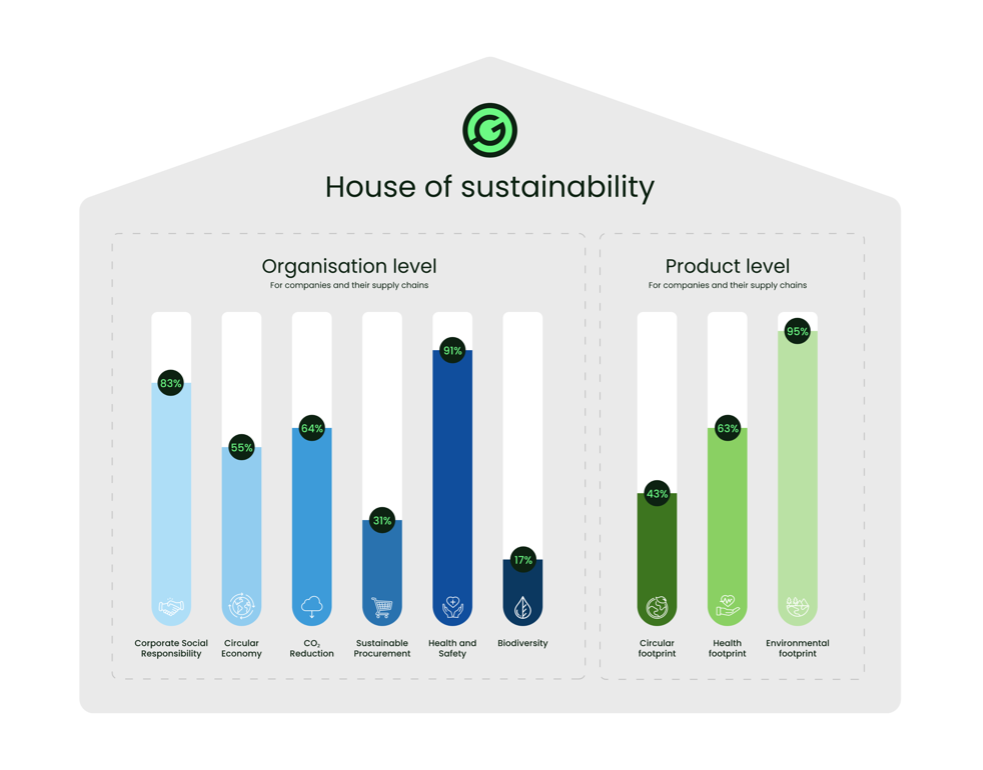
- Sustainable Procurement (based on ISO 20400)
- Biodiversity (based on UNDP)
- Circular Economy (based on BS 8001)
- Health and Safety (based on ISO 45001)
- CO2 Reduction (based on ISO 50001, ISO 14064-1)
In the Netherlands, GSES works with companies such as Xenos, Wibra, ABN AMRO, Univé, the Ministry of Foreign Affairs, and Air Traffic Control the Netherlands (LVNL).
In the two boxes, strategic procurement advisor Willem de Jager of Univé Group and contracting manager Eric Sessink of LVNL share their experiences with GSES.
Action Plan
Sustainability measurement is just the beginning. It’s good to know where every supplier stands, but embedding the real strategy only begins after that. It’s recommended to establish an action plan. This allows you to start discussions with suppliers about their contribution to your own sustainability goals and/or include sustainability ambitions in contracts.
Insight
To really make progress in this area, insight is essential. The requirements that sustainable procurement places on organizations and individuals will grow with future legislation and market developments. Therefore, sustainability will always remain a key concern for the procurement discipline in the future.
UNIVÉ GROUP

Willem de Jager, strategic procurement advisor at Univé Group: “In the context of CSR, Univé focuses on all Sustainable Development Goals, with extra emphasis on ‘Good Health and Well-being,’ ‘Climate Action,’ and ‘Partnerships.’ With the sustainability ambitions of Univé, Procurement and Contract Management must work to create impact in the supply chain. Just like black figures, green figures start with reliable data. When it comes to sustainability, we’re actually hardly aware of what our partners are doing in this area, so we can’t provide reliable reports. We’ve started placing ourselves on the GSES sustainability platform.
At the same time, we’ve asked our suppliers to do the same and, like us, be transparent. First and foremost because we want to know if a sustainable relationship with them also means a collaboration that has positive effects in terms of sustainability, but also to provide suppliers with a platform where they can show where they stand and what their ambitions are. A supplier’s scores in GSES are also accessible to other clients, so this system is a powerful tool for their tendering processes. The verified data in GSES reduces the chances of greenwashing and ensures that we can have quicker discussions about the substance of the collaboration. We can also provide reliable reports about where we stand. In the coming period, we want to work with suppliers to review the scores and identify opportunities for further sustainability.”
LVNL
Eric Sessink, contracting manager at Air Traffic Control the Netherlands (LVNL): “LVNL ensures the safe handling of air traffic in Dutch civilian airspace. Based on three pillars (climate, circularity, and health & social), goals have been set towards a sustainable LVNL. Socially responsible procurement is an essential tool to accelerate sustainability. To use sustainability as a distinguishing factor in tenders, we sought a tool that can objectively assess the sustainability claims of suppliers. The tool must be accessible to both Dutch and international suppliers and must have a robust certification process with a large supplier database. Based on this, GSES emerged as the best option. With this tool, we can see how our suppliers are performing in sustainability. It also provides information that helps us start discussions to improve and monitor this process.
Another advantage of the GSES platform is that a supplier is easily compared to the average in their sector. LVNL’s sustainability goals are incorporated into tenders to challenge suppliers to contribute to them. Additionally, last year we invited the top 200 current suppliers to register on the GSES platform in the areas of Corporate Social Responsibility, CO2 Reduction, and Circular Economy. LVNL also fills out the assessment. This allows the outside world to see what efforts we’re making in this area. Of the approximately 200 current suppliers, 31 have voluntarily registered so far. Eleven of these suppliers have been validated by GSES on their sustainability performance. Starting in 2023, more ambitious criteria will be included in every tender. Currently, registration on the three pillars is voluntary for our suppliers. However, depending on how the market develops, we may make the industry average a minimum requirement in tenders.”
Share this post