


ASWatson A-Brands
Sustainability at AS Watson
At AS Watson, we believe that together we can make a difference. Through our brands and products, we reach millions of consumers every day. This brings not only opportunities, but also responsibilities.
By making conscious choices, collaborating with our partners and gaining insight into the impact of our products, we are working towards a more sustainable future. Transparency and collaboration throughout the supply chain are essential to achieving this.
To achieve our sustainability ambitions, we need insight into the products we sell. Which materials are used? What is their environmental impact? And where do the raw materials come from?
By working together with our A-brands and suppliers to collect reliable product information, we increase transparency throughout the supply chain and enable better-informed decisions.
Together, we make our sustainability impact visible.

About GSES
As an A-brand, you play an important role in making our product supply chain more sustainable. By making your product data available through GSES, you contribute to greater transparency, better insights and a future-proof partnership.
With GSES, we bring product and sustainability data together on a single platform. This information not only provides insight into the environmental impact of products but can also support other information requirements.
Examples include:
- EUDR: Information about relevant raw materials and their origins.
- PPWR: Data on packaging and packaging materials.
- DPP (Digital Product Passport): Product information for digital product passports.
By making smart use of existing data, we reduce duplicated work and lay the foundation for future information and reporting requirements.
Join GSES and help build a more sustainable supply chain.
Together, we make product data valuable and sustainability tangible.
What is ASWatson asking of your organization?
Through the GSES platform, suppliers can share their organization’s sustainability information with ASWatson and have it independently verified. Depending on your organization and the data available, this includes:
To start, upload all your organization’s sustainability certificates onto the GSES platform and request the independent validation of those certificates to receive a baseline measure of your sustainability performance. Examples of certificates are: ISO’s, CO2 Performance Ladder, CSR Performance Ladder or Ecovadis.
Complete the following GSES assessments:

CSR
Corporate Social Responsibility

CO₂
CO2 Reduction

CE
Circular Economy

SP
Sustainable Procurement
Complete the following GSES assessments:
CSR
Corporate Social Responsibility
CO₂
CO2 Reduction
CE
Circular Economy
SP
Sustainable Procurement
This allows us to build a clearer understanding of the sustainability of our products, step by step.
GSES provides full support during onboarding and data submission. If you need any help, our support team is available at [email protected].

How to do it!
Submit product information
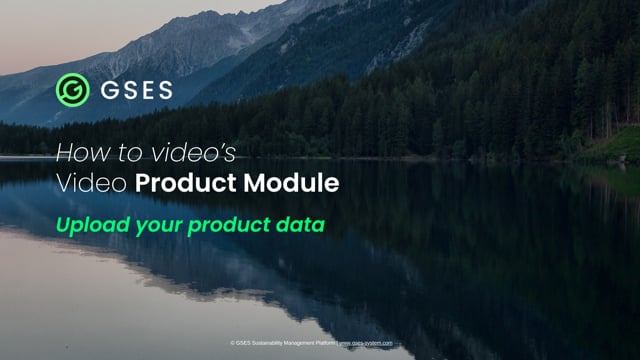
This process ensures a balance between ease of participation and data credibility.
FAQ
- Data ownership remains with your organization. GSES only processes the data and does not claim ownership.
- Certificates (e.g. ISO, CO₂ Performance Ladder) are uploaded by you and validated by an independent certifying body.
- Certificates cannot be downloaded by others and are only visible in summary form (logo, status, validity).
- Assessment answers are verified and shown on your scorecard; answers cannot be edited after submission.
- Burden of proof (e.g. internal documents) is stored in a Virtual Safe and only accessible to you and the auditor. The documents are not visible on your scorecard.
- You control scorecard visibility: set your ESG Scorecard to Public (visible to all) or Private (only visible to you).
- If preferred private, GSES Members can request access to view your scores; you receive a notification and can accept or decline the request.
Joining GSES is highly encouraged. Transdev is placing increasing emphasis on sustainability and transparency across its supply chain. By sharing your sustainability data via the GSES platform, your organization shows commitment to future-proof, responsible business. It helps strengthen your position as a preferred supplier and ensures you’re aligned with Transdev’s long-term goals.
To share the required sustainability data with Transdev, your organization needs a GSES Pro Membership. This enables you to create and share an ESG scorecard, manage certificates, track CO2 emissions, and collaborate with up to 5 colleagues. You can upload existing certificates and complete assessments, which are then independently validated through the GSES platform.
Transdev suppliers receive a discounted GSES Pro Membership based on annual turnover:
- €1,900/year (turnover €0–10M)
- €2,500/year (turnover €10–100M)
- €3,700/year (turnover >€100M)
This includes access to the organization module and 4 desk audits per year for the required GSES pillars. The contract has a duration of 3 three years.
All prices are excl. VAT.
The largest time commitment for your organization is in qualitatively answering the assessments and collecting the underlying documents that serve as evidence. Below is an overview of the processing times.
Time commitment and lead time:
- Create an account: 2 minutes for you as a user (name & email address) to register your organization.
- Uploading certificates and requesting validation: up to 5 minutes.
Lead time of independent audit by certifying body:
- Validation of 1st line certificate: 2 working days.
- Validation 2nd-line certificate: up to 10 working days.
- Verification of Assessments by means of a desk audit: 10 – 15 working days.
You may need various colleagues to fill in the assessment, this can differ per organization but also per GSES Pillar. Think of colleagues from a sustainability team or the contract and procurement team. You can give up to 5 colleagues access to your organization’s online environment.
Data ownership and accessibility.
- The information you provide remains the property of your organization. GSES will only have the right to process the data, without transferring ownership rights.
- You always have full access to your organization’s own information and can view it.
- Important: After submitting an assessment, you cannot edit your answers anymore.
Processing and visibility of certificates (ISO, CO2 Performance Ladder, Ecovadis, etc.)
- Certificates are uploaded by you and forwarded to an independent certifying body for validation.
- You can always view and/or delete your organization’s certificates.
- The scorecard will display the certificate’s logo, including its validation status and validity.
- The score report states whether a certificate contributes to your score. The certificate itself cannot be downloaded by others.
Processing and visibility of assessments and burden of proof
- When filling in a questionnaire, the following elements are recorded:
- Answer: multiple-choice options from the GSES Standard
- Context: explanation for the auditor
- Burden of proof: internal documents as burden of proof
How is this processed and visible?
- The answer will be visible on the scorecard after verification.
- The burden of proof is stored in a secure safe. Only your organization and the auditor have access to this. This is not visible on the scorecard.
Visibility and scoring management
- You decide who can view your scorecard: Public (visible to everyone) or Private (visible only to you).
- Even with a private setup, customers can link you as a supplier, but they won’t see scores.
- Does another GSES Member want to see your scores? They can send a Visibility Request. You will receive an email and can accept or deny access.
Organizations are fully responsible for the accuracy and ownership of any data uploaded to the platform. By submitting data, they confirm it is truthful and accurate to the best of their knowledge.
Auditors independently assess whether the data is verifiable and meets the required standards. The platform itself is not responsible for the content or accuracy of submitted data.
Are you excited and ready to get started? We will help you on your way. On this landing page you will find all the steps you need to follow in the “Getting started with GSES” section.
In addition to the functionalities that a GSES Pro membership brings, your organization can do much more with the GSES platform, for example, the GSES platform can:
- Enter and validate sustainability information about your products.
- Mapping the sustainability performance of your supply chain.
- Use other parts of the platform such as the CSRD module, the event module and/or the asset module;
- Compare suppliers on sustainability performance in the GSES database.
If you want to know more about the above functionalities and possibilities for your organization, book a demo or contact the GSES Support Team at [email protected].
This FAQ is updated regularly. If you have additional questions feel free to contact us on [email protected].

Action EUDR
Action must comply with the EU Deforestation Regulation (EUDR) by 31 December 2026. The regulation applies to products containing certain raw materials: wood, cocoa, coffee, palm oil, rubber, soy and cattle. To demonstrate compliance, we need to collect specific EUDR information for all in-scope products. The GSES platform helps us collect and assess this data.
Note: If we do not receive the requested data through the GSES system we will no longer be able to sell products we source from you

Register your company on the GSES platform and begin submitting product data.
Get startedWhat does this mean for our suppliers/ you?
We ask you to register on the GSES platform and submit the required information.
Providing complete and accurate data helps Action assess the relevant products before the EUDR deadline. Action may be unable to continue buying products if the required information is missing or cannot be approved.
Registration and data submission are free of charge for Action suppliers.
GSES provides full support with registration and data submission. If you need any help using the platform, contact the GSES support team at [email protected].
What is expected of you?
Follow the steps below to register, prepare and submit the data Action needs to meet the EU Deforestation Regulation.
Create an account on the GSES platform using your company details. You will receive a confirmation email with your login details.
Attend the webinar introducing the EUDR and the information Action requires. You will receive an invite via email.
For each in-scope product, confirm your EUDR role (operator, downstream operator or trader) and enter required EUDR data (DDS number or Y-code).
Ensure all product data is submitted and approved before the deadline. Submit all requested information by December 1st 2026. Action will review the data and contact you if there are any questions.
Register your company on the GSES platform and begin submitting product data.
Get startedWhat data do you need?
For each product, you must have the following information available before you start entering data:
- Bill of Materials (BOM) of each product
- Plot where the regulated material is farmed (GeoJSON file)
- Country of origin of the regulated raw materials
- Type(s) of wood or raw material used
- If applicable: Certificates (FSC, PEFC, etc.)
- Due diligence statements (if available)
- Name and address of the producer/factory
- Material composition of the product
About GSES
GSES is the platform Action uses to collect and assess the product and material information required for the EUDR process.
GSES is a universal, sector-agnostic platform for measuring, rating and verifying sustainability performance across all themes and scopes. It covers your organization, supply chain, products and physical assets, and supports compliance with legislation such as CSRD, EUDR and DPP.
Want to learn more? Book a free demo and discover how GSES can support your sustainability journey.
FAQ
No, Action will tell you which products require information. This depends on the HS-code and the materials it it contains.
Action may be unable to continue buying an in-scope product if the required information has not been submitted and approved by the applicable deadline.
Submit your information on time to allow enough time for review and any necessary corrections
No. The use of GSES platform is free of charge for you. Action covers the subscription costs.
For regulated products, provide the DDS number and its verification number, or a Y-code.
- For questions about which products or information Action requires, contact [email protected].
- For technical support with registration or data submission, contact [email protected].

Responsible Marketing Compass
De merken, marketing- en mediasector staat voor dezelfde uitdaging: hoe maak je verantwoord en duurzaam handelen concreet, meetbaar en vergelijkbaar?
Het Responsible Marketing Compass (RMC), een initiatief van VIA en bvA, brengt marketeers, bureaus, media-exploitanten, platforms, inkoopprofessionals en duurzaamheidsexperts samen rondom één gedeelde standaard voor verantwoorde marketing. Het doel: minder versnippering, meer samenwerking en meer impact.
Het Responsible Marketing Compass is ontwikkeld door professionals uit marketing, ESG, procurement en legal, afkomstig van adverteerders, bureaus, mediaorganisaties en brancheverenigingen.











Sluit je aan
Word onderdeel van een sectorbrede beweging en werk samen met jouw partners aan sterkere, transparantere en toekomstbestendige marketing.
Praktische Informatie
Om toegang te krijgen tot het GSES-platform is een lidmaatschap voor de organisatie vereist. Hiervoor wordt een lidmaatschapsovereenkomst verstrekt. Het proces kan worden gestart via de registratiepagina.
Het begint met het aanmaken van een gebruikersaccount, waarbij naam en e-mailadres worden ingevuld. Na het verifiëren van het e-mailadres wordt teruggekeerd naar de registratiepagina, waarna de organisatiegegevens kunnen worden ingevuld.
-
Indien de organisatie al een lidmaatschap heeft, kan ‘Join Organization’ worden geselecteerd en de organisatie worden opgezocht. De hoofdgebruiker ontvangt vervolgens een e-mailbericht om de aanvraag goed te keuren.
-
Indien de organisatie nog geen lidmaatschap heeft, kan ‘Create Organization’ worden geselecteerd en dienen alle velden te worden ingevuld. Deze gegevens zijn onder andere nodig voor de lidmaatschapsovereenkomst.

- Na het voltooien van deze stap neemt GSES contact met je op over de lidmaatschapsovereenkomst.
Een GSES-lidmaatschap voor de organisatie kan worden afgesloten door de lidmaatschapsovereenkomst te laten ondertekenen. Deze wordt verstrekt zodra de online registratie wordt gestart of wanneer er een bericht is gestuurd.
Je kunt het aanmeldproces starten via onze registratiepagina. Eerst wordt er een persoonlijk account aangemaakt, waarna ook de organisatie geregistreerd kan worden.
Het doorlopen van de registratiestappen neemt enkele minuten in beslag. Als alles duidelijk en compleet is ontvang je binnen enkele werkdagen de lidmaatschapsovereenkomst via Docusign van ons.
Binnen de organisatie is één collega aangewezen als hoofdgebruiker in het GSES-platform. De hoofdgebruiker kan via de Team-module in het platform collega-gebruikers beheren, verwijderen en toevoegen.
Het is ook mogelijk om zelf de registratie te starten en tijdens dit proces bij ‘Join Organization’ een verzoek in te dienen om aan te sluiten bij de organisatie. De hoofdgebruiker ontvangt vervolgens een e-mailbericht om dit verzoek te accepteren.
4tecx
Zevij-Necomij is strengthening its sustainability approach and supply chain collaboration by using the Global Sustainable Enterprise System (GSES) to measure, verify, and report sustainability performance across all its products – giving Zevij-Necomij and its suppliers clear, data-driven, and independently verified insight into their products’ sustainability performance.

This is the first time you are hearing about this project and GSES
In this scenario, the first step is to register your user account and organisation on the GSES platform. This account gives you access to the environment where all 4tecx product data is collected, and it is the starting point for everything that follows in this project.
After this is done, the GSES team will then reach out to schedule your onboarding workshop.
You have worked with GSES before or are currently in contact with them regarding other projects and/or data requests
It is important to note that this is a standalone project initiated by Zevij-Necomij for the collection of 4tecx sustainability data.
If you are already a GSES member, and/or are already registered on the GSES platform, you can skip this step and send an email to [email protected], and the GSES team will provide further guidance.
You have submitted data for Phase 1 of the 4tecx project in 2025
Welcome back! We appreciate your efforts during Phase 1. If you are included in this year’s mailing list, there may still be products for which you need to provide data.
This year, we have a new data collection system in place that makes it easier and more user-friendly for you to provide the necessary data. For this, you need a user account and organisation on the GSES platform, which is fully funded by Zevij-Necomij for the sake of this project.
Once you are registered or reach out to the GSES support email, GSES can give you information specific to your situation, with exact EANs, and further instructions.
How to do it!
Submit product information
This process ensures a balance between ease of participation and data credibility.
FAQ
All suppliers of all products in Zevij-Necomij’s 4tecx line are asked to share these products’ sustainability information with Zevij-Necomij through the GSES platform.
Participation is not enforced, however it is highly encouraged and appreciated in order for Zevij-Necomij to meet their sustainability goals.
The costs for this project are zero, all the suppliers’ membership fees and participation on the platform are fully covered by Zevij-Necomij to encourage participation. This is limited to the audit of only products in the 4tecx range, however as a supplier if you are interested in a GSES membership for your own needs, please contact [email protected] and we’d be happy to provide you with all the necessary information.
Your first step is to register your user and organization on the GSES platform:
You can submit data via the platform, where you will receive a request from Zevij-Necomij to submit data for each specific product you supply to the 4tecx line. Exact instructions on how to do this will be given to you during your workshop with GSES.
Only Zevij-Necomij will have access to your product data. Additionally, you have the option to hide your Bill of Materials from Zevij-Necomij, so the only information they have access to is the sustainability information generated by the Bill of Materials, and the other uploaded evidence.
Yes, although, having an LCA means you do not need a Bill of Materials. You can submit your LCA values in order to calculate a score that is more specific and accurate to your product than the Bill of Materials method. The method of providing this information will be shown to you in the workshop.
The scope of the Nature Impact Score is Cradle to Gate as standard. If you supply additional data and evidence for the gate to market transport, this scope can be increased and lead to a better score.
For building products, the GSES platform also allows you to add use phase and end-of-life data, which is visualised on the product score card, though not included in the score.
After you have finished uploading the data and submitting it to Zevij-Necomij, your work is done. Zevij-Necomij then submits the products for an audit through GSES partner Audit Independer.
Audit Independer subsequently assigns the audit to an accredited conformity
While submitting data, you have the option to save a draft and revisit the submission request again as many times as you want. If you have already submitted the data, and need to change the data after this point, you can reach out to [email protected], or submit a ticket directly on the platform. After which, we can resend you the data request for you to edit the data as you see fit.
Please make sure to flag this in good time, as once the data reaches the Auditor, changing it is not easily done anymore.
This FAQ is updated regularly. If you have additional questions feel free to contact us on [email protected].
Kwantum
As of the 30th of December 2026 we need to be in compliance with the European Deforestation Regulation (EUDR). For us to be able to be compliant we need additional data from our suppliers (you) concerning the materials in the products we source from you, the provenance of said materials and the legality of production of those materials. The GSES system will help us gather and assess the data.
Note: If we do not receive the requested data through the GSES system we will no longer be able to sell products we source from you
What does this mean for our suppliers/ you?
To meet our regulatory obligations, we work with the GSES platform to collect and validate product- and material data in a standardized way.
Providing the requested data through GSES is a condition for us to continue buying products from you. Without it, we are unable to guarantee the compliance our business requires and risk large fines.
Therefore we ask all our suppliers (including you) to register on the GSES platform and share the requested product data. For you this will be free of charge.
GSES provides full support during onboarding and data submission. If you need any help, our support team is available at [email protected].
What is expected of you?
Follow the steps below to register, prepare and submit the data Kwantum needs to meet the EU Deforestation Regulation.
Go to the GSES Platform and create an account using your company details. You'll receive a confirmation email with your login details.
Attend a session where GSES explains how to collect and submit the EUDR-related data of your products on the platform.
For each product, enter origin data, raw-material composition and available certificates. You can also do this via a bulk upload using the Excel template provided by the platform.
Add certificates such as FSC, PEFC or due-diligence statements. These will be verified and linked to your products.
Ensure all product data is submitted and approved before the deadline. After submission, Kwantum will review the data and contact you if there are any questions.
Register your company on the GSES platform and begin submitting product data.
Get startedWhat data do you need?
For each product, you must have the following information available before you start entering data:
- Bill of Materials (BOM) of each product
- Plot where the regulated material is farmed (GeoJSON file)
- Country of origin of the regulated raw materials
- Type(s) of wood or raw material used
- If applicable: Certificates (FSC, PEFC, etc.)
- Due diligence statements (if available)
- Name and address of the producer/factory
- Material composition of the product
About GSES
The GSES platform is a universal, sector-agnostic solution for measuring, rating and verifying sustainability performance across sustainability themes and scopes.
With a holistic approach, the platform covers sustainability on every front — from your own organization to your supply chain, products, and physical assets — while aiding in compliance with key legislation such as CSRD, EUDR, and DPP, among others.
All data on the GSES platform is verified by independent third parties, such as accredited certification bodies. This verification process is central to our mission: it prevents greenwashing and ensures fair, transparent, and comparable sustainability performance measurement and reporting across organizations.
Want to learn more? Book a free demo and discover how GSES can support your sustainability journey.
FAQ
No, Kwantum will decide for which products you need to supply data. This mainly depends on the materials used.
A certificate is not always mandatory, but you must be able to demonstrate the origin of your raw materials. This can also be done via a written due diligence statement from your supplier. Contact us if you need help preparing this.
Yes. The GSES platform offers a bulk upload via Excel. You can upload a completed template with all product data at once. The template is available after logging into the platform.
Products without approved product data in GSES can no longer be sold via Kwantum after 30 December 2026. This is a legal EU requirement that Kwantum must comply with. Timely submission is therefore essential.
Reminder: If this data is not in the GSES platform by August 7th 2026 we can no longer do business with you.
Leen Bakker
As of the 30th of December 2026 we need to be in compliance with the European Deforestation Regulation (EUDR). For us to be able to be compliant we need additional data from our suppliers (you) concerning the materials in the products we source from you, the provenance of said materials and the legality of production of those materials. The GSES system will help us gather and assess the data.
Note: If we do not receive the requested data through the GSES system we will no longer be able to sell products we source from you
What does this mean for our suppliers/ you?
To meet our regulatory obligations, we work with the GSES platform to collect and validate product- and material data in a standardized way.
Providing the requested data through GSES is a condition for us to continue buying products from you. Without it, we are unable to guarantee the compliance our business requires and risk large fines.
Therefore we ask all our suppliers (including you) to register on the GSES platform and share the requested product data. For you this will be free of charge.
GSES provides full support during onboarding and data submission. If you need any help, our support team is available at [email protected].
What is expected of you?
Follow the steps below to register, prepare and submit the data Leen Bakker needs to meet the EU Deforestation Regulation.
Go to the GSES Platform and create an account using your company details. You'll receive a confirmation email with your login details.
Attend a session where GSES explains how to collect and submit the EUDR-related data of your products on the platform.
Schedule a sessionFor each product, enter origin data, raw-material composition and available certificates. You can also do this via a bulk upload using the Excel template provided by the platform.
Add certificates such as FSC, PEFC or due-diligence statements. These will be verified and linked to your products.
Ensure all product data is submitted and approved before the deadline. After submission, Leen Bakker will review the data and contact you if there are any questions.
Register your company on the GSES platform and begin submitting product data.
Get startedWhat data do you need?
For each product, you must have the following information available before you start entering data:
- Bill of Materials (BOM) of each product
- Plot where the regulated material is farmed (GeoJSON file)
- Country of origin of the regulated raw materials
- Type(s) of wood or raw material used
- If applicable: Certificates (FSC, PEFC, etc.)
- Due diligence statements (if available)
- Name and address of the producer/factory
- Material composition of the product
About GSES
The GSES platform is a universal, sector-agnostic solution for measuring, rating and verifying sustainability performance across sustainability themes and scopes.
With a holistic approach, the platform covers sustainability on every front — from your own organization to your supply chain, products, and physical assets — while aiding in compliance with key legislation such as CSRD, EUDR, and DPP, among others.
All data on the GSES platform is verified by independent third parties, such as accredited certification bodies. This verification process is central to our mission: it prevents greenwashing and ensures fair, transparent, and comparable sustainability performance measurement and reporting across organizations.
Want to learn more? Book a free demo and discover how GSES can support your sustainability journey.
FAQ
No, Leen Bakker will decide for which products you need to supply data. This mainly depends on the materials used.
A certificate is not always mandatory, but you must be able to demonstrate the origin of your raw materials. This can also be done via a written due diligence statement from your supplier. Contact us if you need help preparing this.
Yes. The GSES platform offers a bulk upload via Excel. You can upload a completed template with all product data at once. The template is available after logging into the platform.
Products without approved product data in GSES can no longer be sold via Leen Bakker after 30 December 2026. This is a legal EU requirement that Leen Bakker must comply with. Timely submission is therefore essential.
Reminder: If this data is not in the GSES platform by DEADLINE we can no longer do business with you.
AVEX
AVEX is taking an important step in its sustainability strategy by using GSES to gain greater oversight of its supply chain.
Sustainability that is measurable and transparent
At AVEX, we are committed to smart and sustainable AV solutions on a daily basis. Sustainability is not a non-binding promise for us. That’s why we make it easier for our customers and partners to make sustainable choices. By joining the Global Sustainable Enterprise System (GSES), we ensure transparency in our sustainability performance.
Have you been referred to GSES through AVEX and still have practical questions about how the GSES platform works?
Book a free demo and see it in action.
What does AVEX ask of my organization?
Avex asks that you enter sustainability information about your organization into the GSES platform in order to have it independently validated for the following components:
To start, upload all your certificates onto the GSES platform to receive a baseline measure of your sustainability performance. Examples of certificates include: ISOs, CO2 Performance Ladder, CSR Performance Ladder, and Ecovadis
CSR
Corporate Social Responsibility
CO₂
CO2 Reduction
CE
Circular Economy
SP
Sustainable Procurement
You can complete the assessments and have your certificates independently validated by a certifying body directly via the platform.
Participation in this process requires a Pro Membership, which includes verification of the four requested pillar assessments (certificate validations are not included).
GSES provides full support during onboarding and data submission. If you need any help, our support team is available at [email protected].
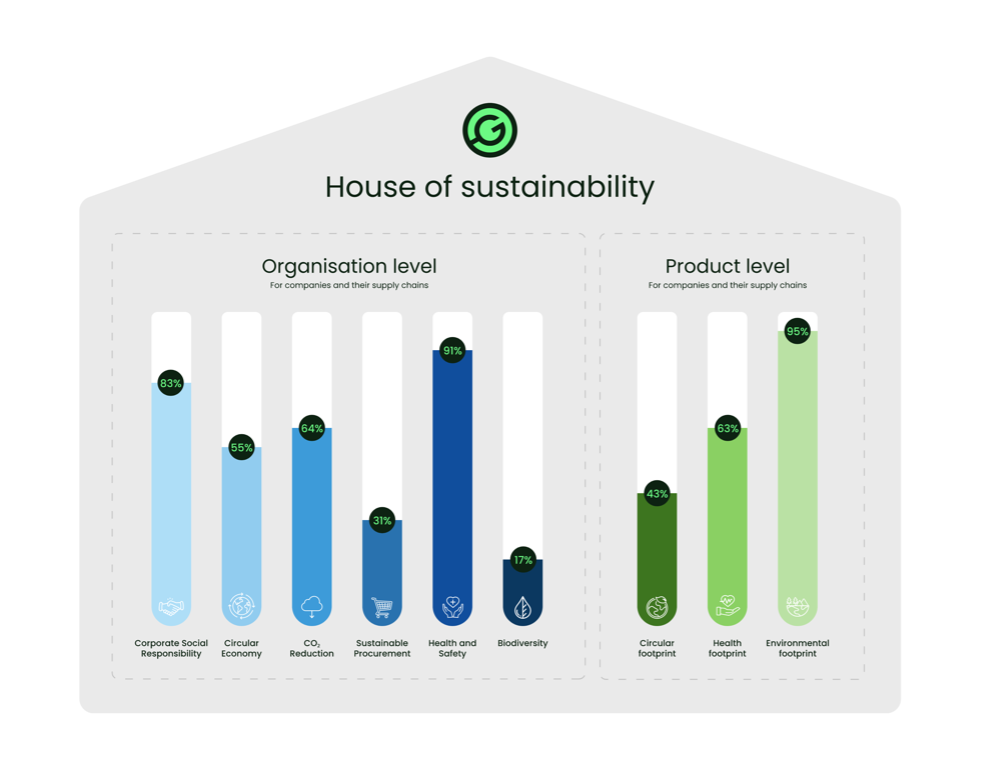
How to do it!
Register on the GSES Platform

FAQ
- Data ownership remains with your organization. GSES only processes the data and does not claim ownership.
- Certificates (e.g. ISO, CO₂ Performance Ladder) are uploaded by you and validated by an independent certifying body.
- Certificates cannot be downloaded by others and are only visible in summary form (logo, status, validity).
- Assessment answers are verified and shown on your scorecard; answers cannot be edited after submission.
- Burden of proof (e.g. internal documents) is stored in a Virtual Safe and only accessible to you and the auditor. The documents are not visible on your scorecard.
- You control scorecard visibility: set your ESG Scorecard to Public (visible to all) or Private (only visible to you).
- If scorecard visiblity is set to private, other GSES members can still request access to view your scores; you will recieve a notification and can accept or decline the request.
Joining GSES is highly encouraged. AVEX is placing increasing emphasis on sustainability and transparency across its supply chain. By sharing your sustainability data via the GSES platform, your organization shows commitment to future-proof, responsible business. It helps strengthen your position as a preferred supplier and ensures you’re aligned with AVEX’s long-term goals.
To share the required sustainability data with AVEX, your organization needs a GSES Pro Membership. This enables you to create and share an ESG scorecard, manage certificates, track CO2 emissions, and collaborate with up to 5 colleagues. You can upload existing certificates and complete assessments, which are then independently validated through the GSES platform.
AVEX suppliers receive a discounted GSES Pro Membership based on annual turnover:
- €1,900/year (turnover €0–10M)
- €2,500/year (turnover €10–100M)
- €3,700/year (turnover >€100M)
This includes access to the organizational module and 4 desk audits per year for the required GSES pillars. The contract has a duration of 3 three years.
All prices are excl. VAT.
The largest time commitment for your organization is in qualitatively answering the assessments and collecting the underlying documents that serve as evidence. Below is an overview of the processing times.
Time commitment and lead time:
- Create an account: 2 minutes for you as a user (name & email address) to register your organization.
- Uploading certificates and requesting validation: up to 5 minutes.
Lead time of independent audit by certifying body:
- Validation of 1st line certificate: 2 working days.
- Validation 2nd-line certificate: up to 10 working days.
- Verification of Assessments by means of a desk audit: 10 – 15 working days.
You may need various colleagues to fill in the assessment, this can differ per organization but also per GSES Pillar. Oftentimes, colleagues from a sustainability team or the contract and procurement team have the required information. You can give up to 5 colleagues access to your organization’s online environment.
Data ownership and accessibility.
- The information you provide remains the property of your organization. GSES will only have the right to process the data, without transferring ownership rights.
- You always have full access to your organization’s own information and can view it.
- Important: After submitting an assessment, you cannot edit your answers anymore.
Processing and visibility of certificates (ISO, CO2 Performance Ladder, Ecovadis, etc.)
- Certificates are uploaded by you and forwarded to an independent certifying body for validation.
- You can always view and/or delete your organization’s certificates.
- The scorecard will display the certificate’s logo, including its validation status and validity.
- The score report states whether a certificate contributes to your score. The certificate itself cannot be downloaded by others.
Processing, visibility of assessments, and burden of proof
- When filling in a questionnaire, the following elements are recorded:
- Answer: multiple-choice options from the GSES Standard
- Context: explanation for the auditor
- Burden of proof: internal documents as burden of proof
How is this processed and visible?
- The answer will be visible on the scorecard after verification.
- The burden of proof is stored in a secure safe. Only your organization and the auditor have access to this. This is not visible on the scorecard.
Visibility and scoring management
- You decide who can view your scorecard: Public (visible to everyone) or Private (visible only to you).
- Even with a private setup, customers can link you as a supplier, but they won’t see scores.
- Does another GSES Member want to see your scores? They can send a Visibility Request. You will receive an email and can accept or deny access.
Organizations are fully responsible for the accuracy and ownership of any data uploaded to the platform. By submitting data, they confirm it is truthful and accurate to the best of their knowledge.
Auditors independently assess whether the data is verifiable and meets the required standards. The platform itself is not responsible for the content or accuracy of submitted data.
Are you excited and ready to get started? We will help you on your way. On this landing page you will find all the steps you need to follow in the “Getting started with GSES” section.
In addition to the functionalities that a GSES Pro membership brings, your organization can do much more with the GSES platform, for example, the GSES platform can:
- Enter and validate sustainability information about your products.
- Map the sustainability performance of your supply chain.
- Use other modules on the platform, such as the CSRD module, the event module, and/or the asset module
- Compare suppliers on sustainability performance in the GSES database.
If you want to know more about the above functionalities and possibilities for your organization, book a demo or contact the GSES Support Team at [email protected].
This FAQ is updated regularly. If you have additional questions feel free to contact us on [email protected].
PPP
Promotional Products Professionals | PPP is de enige branchevereniging voor distributeurs en leveranciers van promotionele producten, relatie- en kerstgeschenken. PPP is een professionele, onafhankelijke organisatie, die wordt bestuurd door gedreven managers uit de branche.
PPP werk vanuit een actief verenigingsverband aan de verder ontwikkeling van de branche. Ethisch, verantwoord en duurzaam handelen zijn daarin kernwaarden. Om onderbouwde ethische, verantwoorde en duurzame keuzes te maken is inzicht nodig. Daarom heeft PPP contact gelegd met GSES.
“Door het gebruik van het GSES platform bij onze leden te stimuleren hopen wij vergelijkbare duurzame data over producten en leveranciers binnen onze branche beter”Carmen Planije, Directeur van Promotional Products Professionals

Waarom promoot PPP het gebruik van GSES
Voor het maken van onderbouwde duurzame keuzes door jouw organisatie of jullie klanten is de beschikbaarheid van betrouwbare en vergelijkbare data over duurzaamheidsprestaties essentieel. GSES is het enige platform dat het mogelijk maakt om onafhankelijke en vergelijkbare duurzaamheidsdata op product- en organisatieniveau voor jouw organisatie en jullie klanten beschikbaar te maken. Ook beperkt GSES zich niet tot het beschikbaar maken van enkel data over bijvoorbeeld de uitstoot van broeikasgassen maar geeft GSES ook data over circulariteit en health and safety.
Starten met het gebruik van GSES
Het starten met het verzamelen van duurzaamheidsdata kan overweldigend zijn omdat veel partijen niet weten waar te beginnen. GSES heeft meerdere mogelijkheden om laagdrempelig te beginnen en het gebruik van GSES mee te laten groeien met de doelstellingen van jouw organisatie. Wij boeken graag vrijblijvend een demo in om de functionaliteiten van het platform te laten zien en in gesprek te gaan hoe implementatie er voor jouw organisatie uit zou kunnen zien.
Boek een demo
Wil je meer weten over GSES? Heb je vragen of wil je een demo plannen? Gebruik dan de onderstaande link.
User workshop

FAQ
De kosten voor jouw organisatie zijn afhankelijk van welke functionaliteiten je gebruikt. Als je alleen gegevens wilt ontvangen, heb je enkel een lidmaatschap nodig. Als je ook gegevens wilt aanleveren (zoals productregistratie en datavalidatie), betaal je per invoer een vast bedrag bovenop de basislidmaatschapskosten.
Bekijk het onderstaande prijsoverzicht voor meer informatie.
Je kunt beginnen door jezelf en je organisatie hier te registreren.
Zodra je dit hebt gedaan, neemt een teamlid van GSES contact met je op om de behoeften van jouw organisatie te bespreken en een conceptcontract aan te leveren.
Na ondertekening van het contract plannen we een workshop voor jou en je collega’s om te leren hoe je aan de slag kunt gaan.
Het type GSES-lidmaatschap dat jouw organisatie nodig heeft, is afhankelijk van de functionaliteiten die je wilt gebruiken.
Gegevens kunnen op twee niveaus worden aangeleverd.
Organisatie:
Om inzicht te krijgen in de duurzaamheidsprestaties van je organisatie kun je beginnen met het uploaden van alle certificaten die jullie organisatie al bezit. Deze worden vervolgens gevalideerd en leveren jullie organisatie een initiële GSES-score op. Als jullie organisatie geen certificaten bezit of als je aanvullende informatie wilt aanleveren die niet in de certificaten is opgenomen, kun je ervoor kiezen om de zes pijlerassessments in te vullen. Elk assessment bevat ongeveer 15 vragen. Houd er rekening mee dat je bij het invullen van deze assessments bewijsmateriaal moet uploaden in een Virtuele Kluis. Dit bewijsmateriaal wordt geverifieerd door een externe, onafhankelijke auditor en resulteert in een GSES-score op het platform.
Voor meer informatie zie: hier
Producten:
Productinformatie kan op twee manieren worden aangeleverd: ofwel door gegevens uit een LCA aan te leveren, waarbij de LCA dient als bewijs voor de data, ofwel door via het platform een gedetailleerde BoM (Bill of Materials) aan te leveren.
Voor meer informatie zie: hier
Gegevens kunnen op twee niveaus worden aangeleverd.
Organisatie:
Om inzicht te krijgen in de duurzaamheidsprestaties van jouw organisatie kun je beginnen met het uploaden van alle certificaten die jouw organisatie al bezit. Deze worden vervolgens gevalideerd en vormen de basis voor een eerste GSES-score.
Als je organisatie geen certificaten heeft, of als je aanvullende informatie wilt verstrekken die niet in de certificaten is opgenomen, kun je ervoor kiezen om de zes pijlerbeoordelingen (assessments) in te vullen. Elk assessment bevat ongeveer 15 vragen.
Houd er rekening mee dat je voor het invullen van deze beoordelingen bewijsmateriaal moet aanleveren in een Virtuele kluis. Dit bewijsmateriaal wordt gecontroleerd door een externe, onafhankelijke auditor en resulteert in een GSES-score op het platform.
Voor meer informatie, zie: hier
Producten:
Productinformatie kan op twee manieren worden aangeleverd:
-
Door gegevens uit een LCA (Levenscyclusanalyse) te leveren, waarbij de LCA als bewijs dient voor de gegevens.
-
Of door een gedetailleerde stuklijst in te vullen via het platform.
Voor meer informatie, zie: hier
Jouw organisatie bepaalt zelf wie er toegang heeft tot de data van de organisatie.
Belangrijk om te weten is dat je duurzaamheidsdata van producten kunt delen zonder daarbij de BoM (Bill of Materials) of BoI (Bill of Information) van het product openbaar te maken.
DPP-data en EUDR-data kan worden beheerd via het GSES-platform en wordt weergegeven op de productscorecard.
Door je supply chain te koppelen aan het platform, maakt GSES het eenvoudig voor leveranciers om gegevens aan te leveren.
Ja, omdat niet alle LCA’s gelijk zijn, moet de LCA worden geüpload op het platform en onafhankelijk gevalideerd worden.
Daarnaast houdt de GSES Nature Impact Score rekening met extra indicatoren die verder gaan dan een LCA en die afzonderlijk moeten worden opgegeven.
De standaard scope van de NIS (Nature Impact Score) is Cradle to Gate.
Wanneer je aanvullende gegevens en bewijs aanlevert over het transport van de poort tot aan de markt, kan de scope worden uitgebreid — wat kan leiden tot een hogere score.
Voor bouwproducten biedt het GSES-platform bovendien de mogelijkheid om gegevens over de gebruiksfase en end-of-life toe te voegen. Deze informatie wordt weergegeven op de productscorecard, maar telt niet mee in de uiteindelijke score.
De standaardscope van de NIS (Nature Impact Score) is Cradle to Gate.
Wanneer je extra gegevens en bewijsmateriaal aanlevert over het transport van de poort tot aan de markt, kan deze scope worden uitgebreid — wat kan leiden tot een hogere score.
Voor bouwproducten biedt het GSES-platform daarnaast de mogelijkheid om gegevens over de gebruiksfase en de end-of-lifefase toe te voegen. Deze informatie wordt weergegeven op de productscorecard, maar wordt niet meegenomen in de uiteindelijke score.
Nadat je alle gegevens hebt geüpload, kun je een datavalidatie aanvragen via onze partner Audit Independer.
Audit Independer wijst de audit vervolgens toe aan een erkende conformiteitsbeoordelingsinstantie (zoals Kiwa of Control Union) die de audit uitvoert. Zodra de audit is afgerond, ontvang je hierover een bericht van GSES.
Het aanvraagproces voor een audit is volledig geautomatiseerd. Dit betekent dat zowel Audit Independer als GSES direct kosten maken zodra je een audit aanvraagt.
Als er fouten zijn gemaakt in de aangeleverde informatie, kunnen wij de audit niet aanpassen of terugbetalen.
Gegevens kunnen worden aangepast tot het moment dat je een audit aanvraagt.
Het aanvraagproces voor een audit is volledig geautomatiseerd. Dit betekent dat zowel Audit Independer als GSES direct kosten maken zodra je een audit aanvraagt. Als er fouten zijn gemaakt in de aangeleverde informatie, kunnen wij de audit niet meer aanpassen of terugbetalen.
This FAQ is updated regularly. If you have additional questions feel free to contact us on [email protected].
Schiphol
As a valued supplier to the Royal Schiphol Group, you’re not just our partner—you’re a driving force in creating the world’s most sustainable airports.
In line with our commitment to sustainability and transparency, we (Royal Schiphol Group) are taking steps to gain insight into the social and environmental impact of our supply chain. We do this using the Global Sustainable Enterprise System (GSES). This platform helps us identify and collaborate with suppliers who share our dedication to responsible and future focused practices.
As our supplier, we ask you to join us in driving positive change in the aviation sector by supplying your sustainability information through the GSES platform. Doing this you supply validated sustainability data to us (and potential other clients), while also gaining insight into your own sustainability performance and goals.

About GSES
The GSES platform is a universal, sector-agnostic solution for measuring, rating and verifying sustainability performance across sustainability themes and scopes.
With a holistic approach, the platform covers sustainability on every front — from your own organization to your supply chain, products, and physical assets — while aiding in compliance with key legislation such as CSRD, EUDR, and DPP, among others.
All data on the GSES platform is verified by independent third parties, such as accredited certification bodies. This verification process is central to our mission: it prevents greenwashing and ensures fair, transparent, and comparable sustainability performance measurement and reporting across organizations.
Want to learn more? Book a free demo and discover how GSES can support your sustainability journey.
What does Schiphol ask from its suppliers?
As part of Schiphol’s Supplier Check-In process, suppliers are asked to share verified sustainability data. This request is handled separately through the GSES platform, but is an integral part of the Check-In.
Your organization is therefore asked to:
- Enter your sustainability data into the GSES platform, by completing the applicable GSES assessments.
- Have this data verified through the platform by an independent certifier.
- Obtain a GSES Pro membership, which is required to fulfill this request.
Schiphol distinguishes between two groups of suppliers: Asset and IT/Services suppliers.
A tailored data request has been formulated for each group, ensuring that the information collected is relevant to the type of products or services delivered.
CSR
Corporate Social Responsibility
CO₂
CO2 Reduction
CE
Circular Economy
SP
Sustainable Procurement
CSR
Corporate Social Responsibility
CO₂
CO2 Reduction

HS
Health & Safety
SP
Sustainable Procurement
Participation in the GSES platform may also be required in Schiphol tenders, in addition to being part of the Check-In process. By providing this data, suppliers contribute to Schiphol’s broader sustainability goals and help create a transparent, measurable, and verifiable basis for working together on impact reduction.
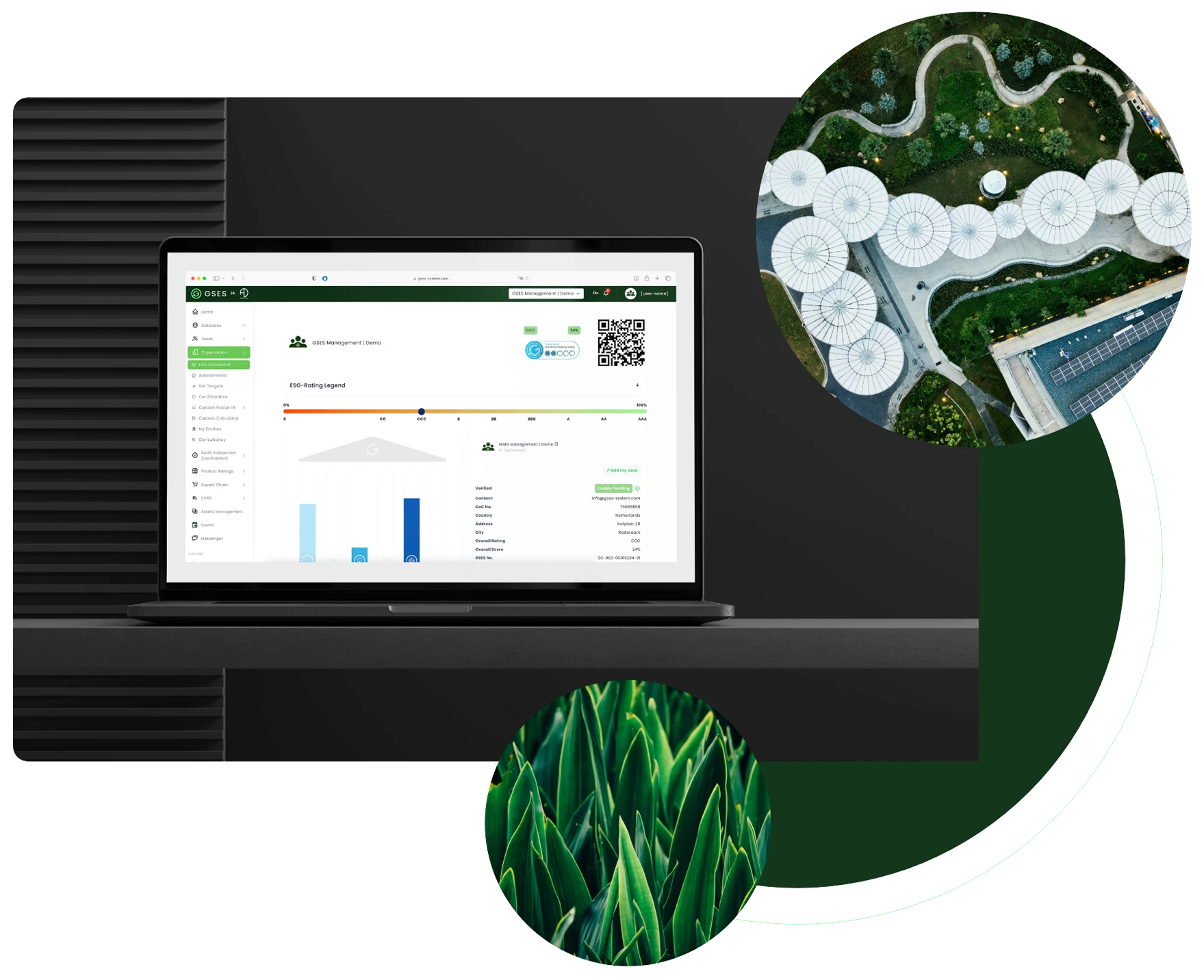
Fill in the info below to get the membership you need to fulfill the Schiphol request
Please provide your company details to get started with the information request.
GSES will subsequently contact you to provide a quote and set out next steps.
Book a demo
Want to know more about GSES? If you have any questions or want to book a demo, use the link below.
How to do it
Register on the GSES Platform
FAQ
To share the required sustainability data with the Royal Schiphol Group, your organization needs a GSES Pro membership. This membership allows you to create and share an ESG scorecard, manage certificates, comply with GSES assessments, track CO₂ emissions, and collaborate with up to five colleagues.
You can upload your organization’s existing certificates to receive a baseline assessment and complete the full GSES assessment process. A Pro membership includes four annual assessment reviews (desk audits), all of which are independently validated through the GSES platform.
With your ESG scorecard, you can monitor your sustainability performance, set future goals, communicate and share your data with clients and other stakeholders, and leverage your performance for external communication purposes.
Schiphol wants to work with its suppliers towards a sustainable and future-proof airport. To do this in a transparent and measurable way, Schiphol requests suppliers to share verified sustainability data. This helps to gain insights into the supply chain and to track progress together.
Yes. The request to provide sustainability data is part of Schiphol’s Supplier Check-In process. The actual data collection and verification takes place separately through the GSES platform, but it is considered an integral element of the Check-In.
An important part of the Check-In is also the continuous improvement of your GSES score on the platform.
-
Enter your sustainability data into the GSES platform.
-
Have this data verified by an independent certifying body via the platform.
-
Obtain a GSES membership, which is required to complete this process.
-
Work on improving your GSES score over time, as part of the Supplier Check-In.
-
Asset suppliers
-
IT/Services suppliers
For both groups, a specific data request has been formulated to ensure that the information collected is relevant to the products or services delivered.
Participation in the GSES platform is part of the Supplier Check-In. In addition, it may also be a requirement in Schiphol tenders. We therefore strongly advise suppliers to participate, as it can influence both ongoing and future business opportunities with Schiphol.
- Data ownership remains with your organization. GSES only processes the data and does not claim ownership.
- Certificates (e.g. ISO, CO₂ Performance Ladder) are uploaded by you and validated by an independent certifying body.
- Assessment answers are verified and shown on your scorecard; answers cannot be edited after submission.
- Burden of proof (e.g. internal documents) is stored in a Virtual Safe and only accessible to you and the auditor. The documents are not visible on your scorecard.
Data ownership and accessibility.
- The information you provide remains the property of your organization. GSES will only have the right to process the data, without transferring ownership rights.
- You always have full access to your organization’s own information and can view it.
- Important: After submitting an assessment, you cannot edit your answers anymore.
Processing and visibility of certificates (ISO, CO2 Performance Ladder, Ecovadis, etc.)
- Certificates are uploaded by you and forwarded to an independent certifying body for validation.
- You can always view and/or delete your organization’s certificates.
- The scorecard will display the certificate’s logo, including its validation status and validity.
- The score report states whether a certificate contributes to your score. The certificate itself cannot be downloaded by others.
Processing and visibility of assessments and burden of proof
- When filling in a questionnaire, the following elements are recorded:
- Answer: multiple-choice options from the GSES Standard
- Context: explanation for the auditor
- Burden of proof: internal documents as burden of proof
How is this processed and visible?
- The answer will be visible on the scorecard after verification.
- The burden of proof is stored in a secure safe. Only your organization and the auditor have access to this. This is not visible on the scorecard.
Organizations are fully responsible for the accuracy and ownership of any data uploaded to the platform. By submitting data, they confirm it is truthful and accurate to the best of their knowledge.
Auditors independently assess whether the data is verifiable and meets the required standards. The platform itself is not responsible for the content or accuracy of submitted data.
The largest time commitment for your organization is in qualitatively answering the assessments and collecting the underlying documents that serve as evidence. Below is an overview of the processing times.
Time commitment and lead time:
- Create an account: 2 minutes for you as a user (name & email address) to register your organization.
- Uploading certificates and requesting validation: up to 5 minutes.
Lead time of independent audit by certifying body:
- Validation of 1st line certificate: 2 working days.
- Validation 2nd-line certificate: 10 working days.
- Verification of Assessments by means of a desk audit: 10 – 15 working days.
You may need various colleagues to fill in the assessment, this can differ per organization but also per GSES Pillar. Think of colleagues from a sustainability team or the contract and procurement team. You can give up to 5 colleagues access to your organization’s online environment.
Are you excited and ready to get started? We will help you on your way. On this landing page you will find all the steps you need to follow in the “Getting started with GSES” section.
By providing verified sustainability data and actively improving your GSES score, your organization demonstrates transparency and commitment to sustainability. This strengthens your partnership with Schiphol and aligns your organization with Schiphol’s broader environmental and social impact goals.
In addition to the functionalities that a GSES Pro membership brings, your organization can do much more with the GSES platform, for example, the GSES platform can:
- Enter and validate sustainability information about your products.
- Mapping the sustainability performance of your supply chain.
- Use other parts of the platform such as the CSRD module, the event module and/or the asset module;
- Compare suppliers on sustainability performance in the GSES database.
If you want to know more about the above functionalities and possibilities for your organization, book a demo or contact the GSES Support Team at [email protected].
This FAQ is updated regularly. If you have additional questions feel free to contact us on [email protected]